HalcyonAI: Virtual Cell Challenge 2026
A virtual AI model of a cell, built without large-scale private data. 11th of 1,500+ teams.
Virtual Cell Challenge 2026
HalcyonAI
Zero-shot prediction of CRISPRi knockdown responses in unseen cell lines
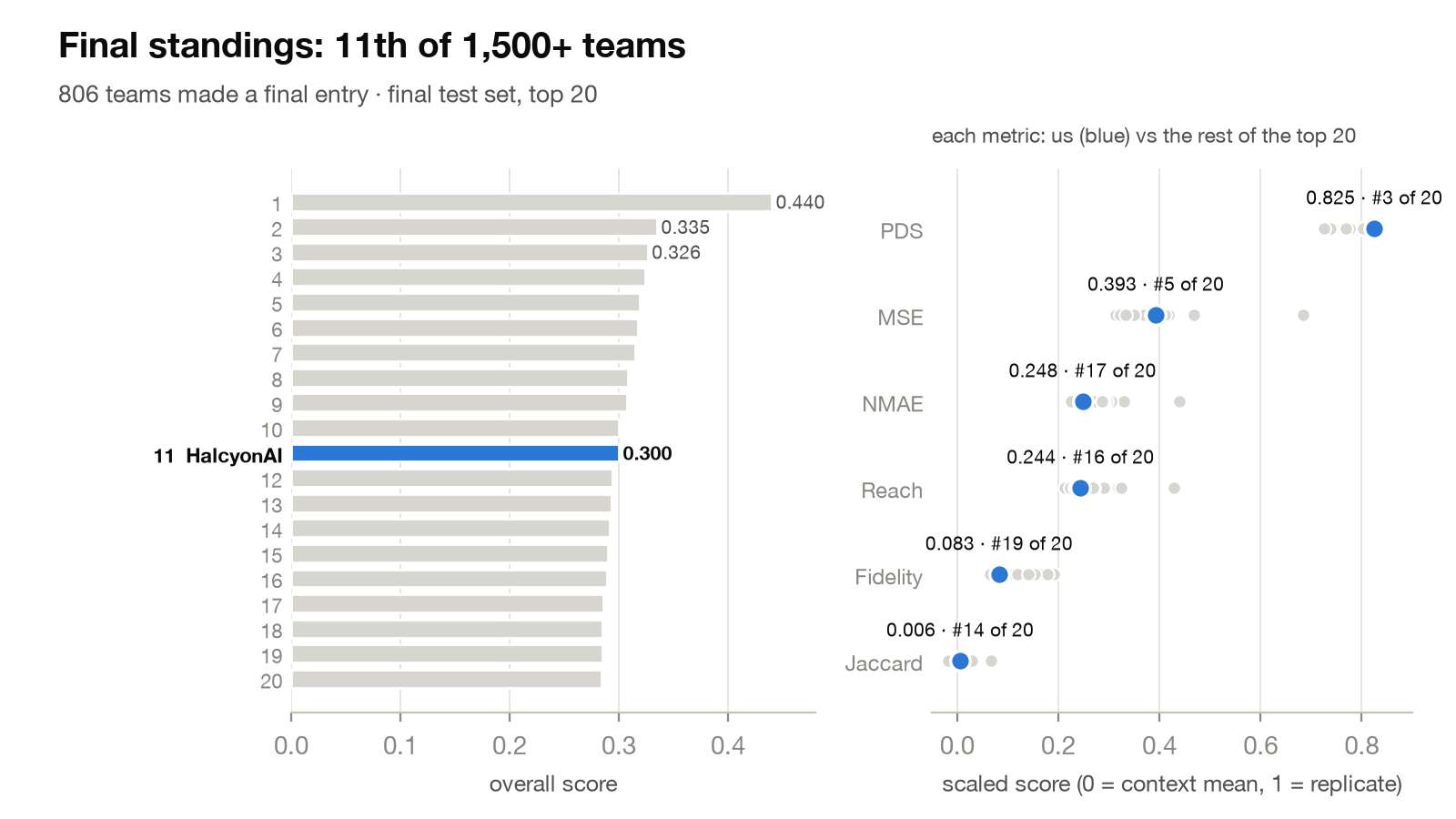
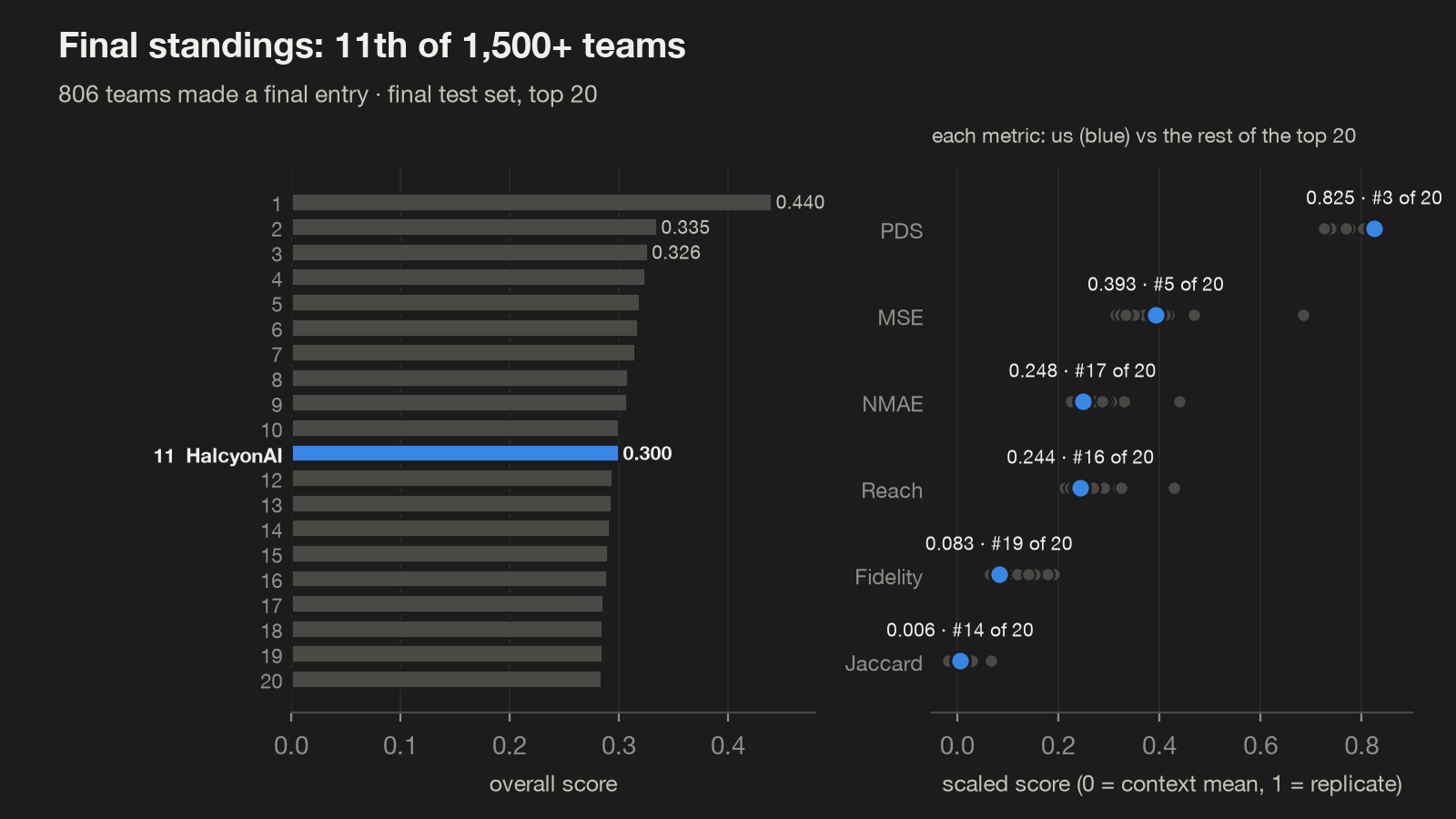
11th of 1,500+ teams
Here is how I placed 11th out of 1,500+ teams around the world in Arc Institute's Virtual Cell Challenge 2026!!!
All without access to large-scale private datasets like the top teams in the challenge.
01The task: a virtual AI model of a cell
Arc Institute's Virtual Cell Challenge 2026 asked teams to predict how 300 CRISPRi gene knockdowns change single-cell gene expression in cell lines with no perturbation data at all, only their unperturbed control cells. Predictions were scored on six metrics covering the bulk expression profile, which genes change significantly, and by how much.
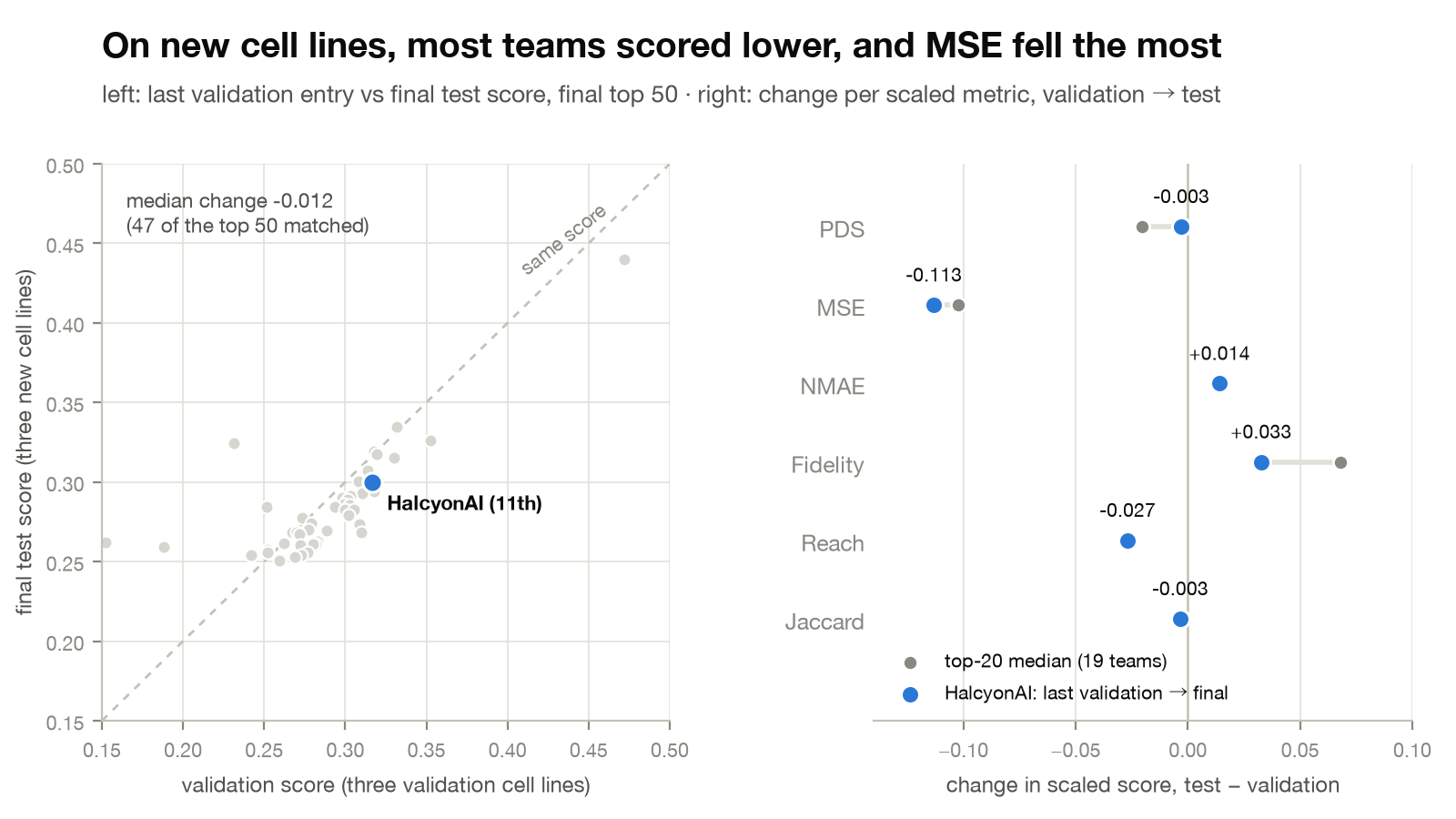
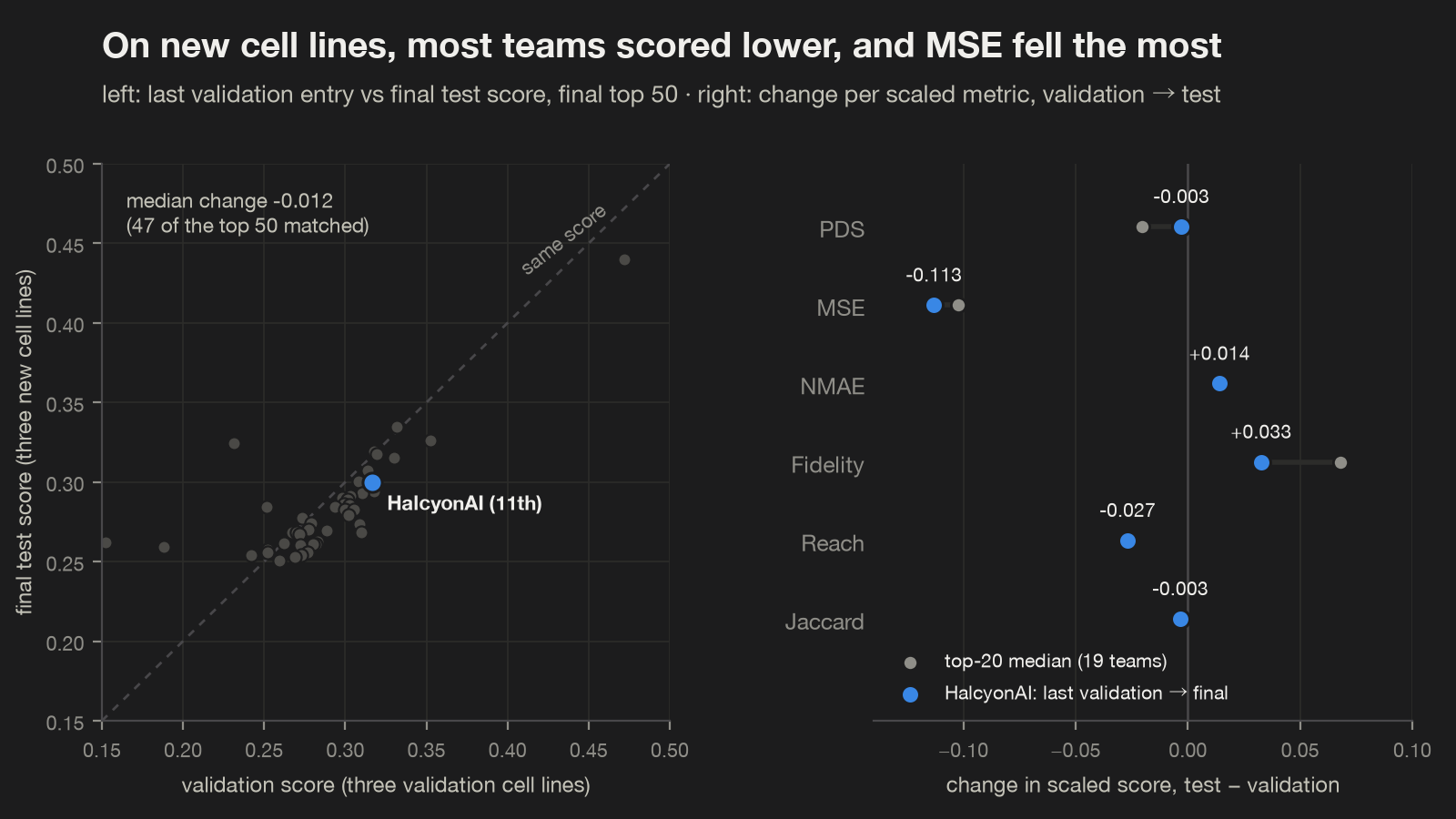
My final model, HalcyonAI, scored 0.300 and had a top-3 perturbation-discrimination score (PDS).
02How I got there
My first model scored terribly, right around the baseline. I tried many approaches early on, but building the model around statistical transfer, carrying measured knockdown responses over from other cell lines, showed the best signs, so I chose to continue down that path. In October I rebuilt the pipeline as HalcyonAI. From there it was one change at a time, each with a predicted score written down before upload. Between October 2 and October 11 it climbed from 141st to 4th on the validation leaderboard.
- First upload: −0.069Responses from one other cell line copied straight onto control cells.
- A long plateau around 0.20Many approaches tried; statistical transfer showed the best signs.
- HalcyonAI v1: +0.035 in one uploadRebuilt around statistical transfer.
- 4th on the validation boardUp from 141st nine days earlier, one change per upload.
- 0.316, my last validation entryTen public donor screens, pooled with random-effects weights.
- The blind final roundThree new cell lines, no feedback, and only the last upload counted.
- 11th of 1,500+ teamsFinal score 0.300, with a top-3 PDS.
After that I kept iterating. Each upload tested one idea: a new public donor screen, a better way to choose which genes change, a smarter way to size each knockdown. Some ideas I had written off came back as wins, like a stem-cell screen I had dismissed in September that later pushed the score past 0.31. Others looked great on my own benchmarks and fell flat on the leaderboard, which taught me to measure how far each benchmark could be trusted.
Fig. 2Every scored validation upload (dots), the best score so far (line) and the final test result (diamond). Hover or tap a point to see what changed.
The final round used three new cell lines, gave no feedback, and counted only the last upload. I identified two of the lines from their control cells alone, built blind benchmarks on real perturbed cells, and shipped only changes that held up on knockdowns they had never seen.
03How it works
Every input is public data.
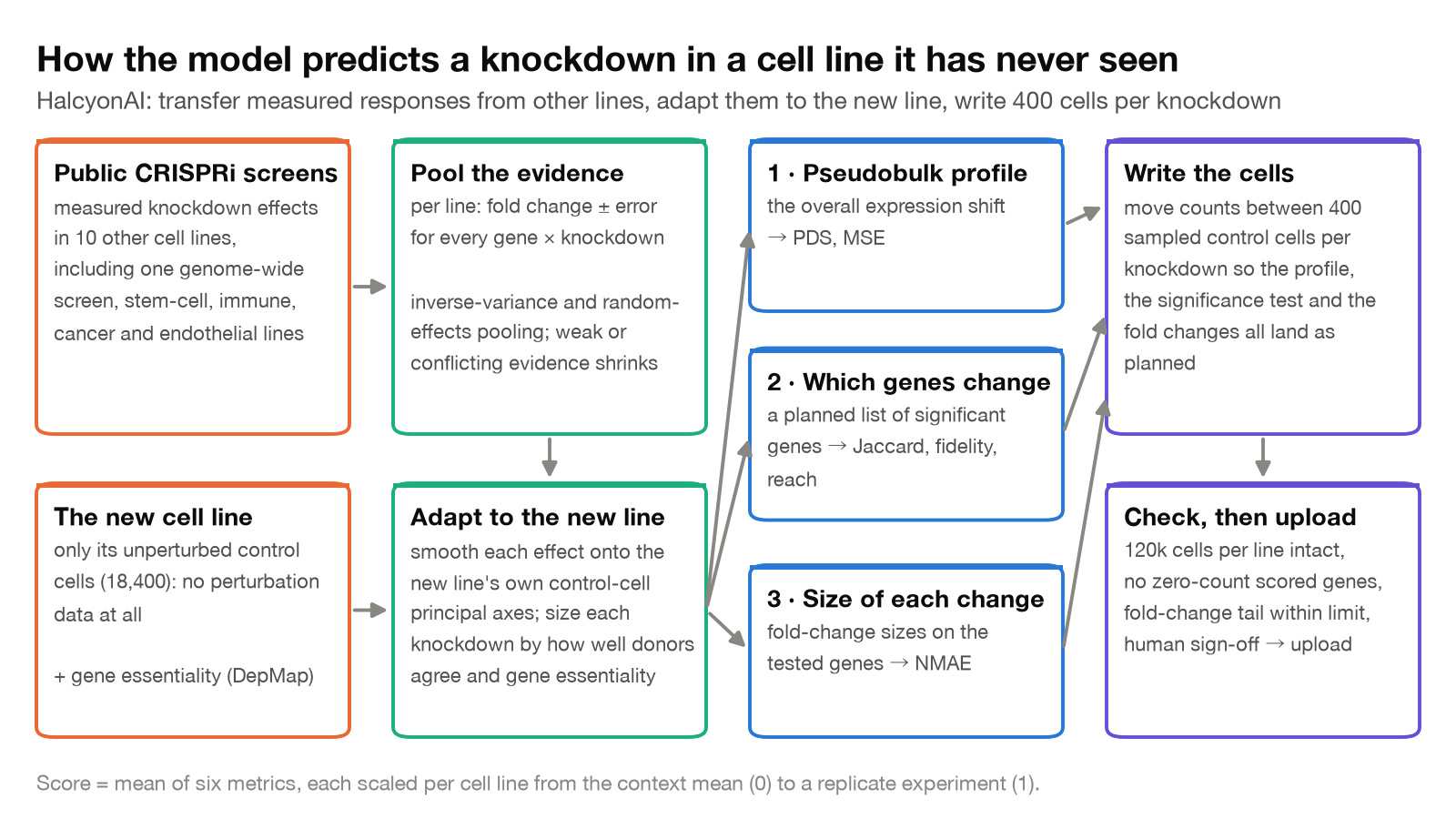
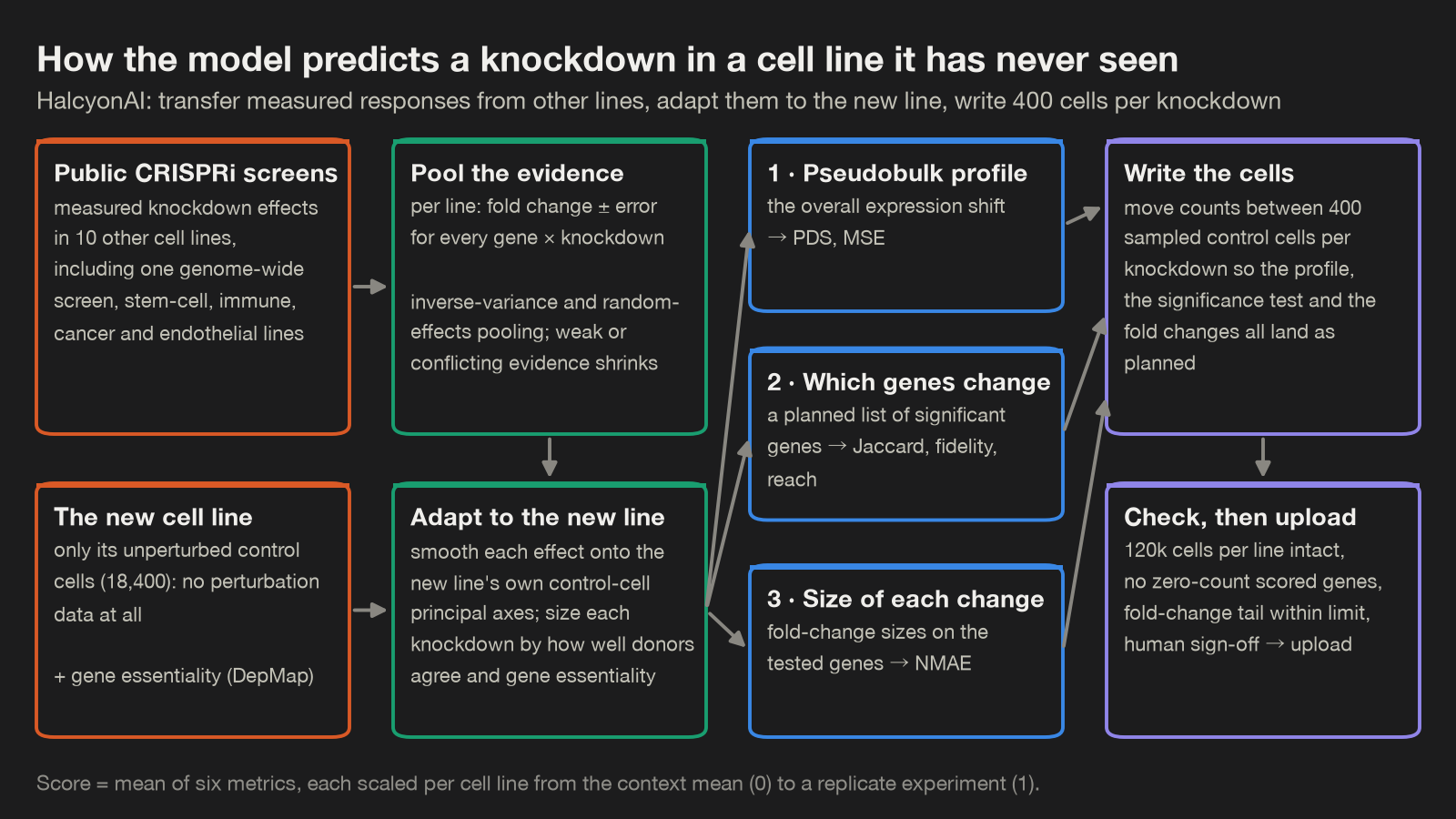
Pool measured knockdown responses from public CRISPRi screens in 10 other cell lines, with inverse-variance and random-effects weights so weak or conflicting evidence shrinks.
Adapt each predicted effect to the new line by smoothing it onto that line's own control-cell principal axes.
Size each knockdown by how well the donor lines agree and by gene essentiality.
Plan the bulk profile, the significant genes and the fold changes separately, then edit real control cells until all three land.
04One human, many agents
One human iterating with AI agents makes a powerful team: 200+ research tasks and written notes, specification-driven agentic coding, a strong verification harness to measure every improvement, and every one of 74 submissions formulated and tested by hand and intuition.
05What I learned
Carefully carrying over what other cell lines show was the strongest signal, even without private data.
A genuinely new public dataset paid off in full; re-processing data I already had paid far less.
Tweaks tuned to the validation set often reversed on new knockdowns, so I kept only the ones that held.
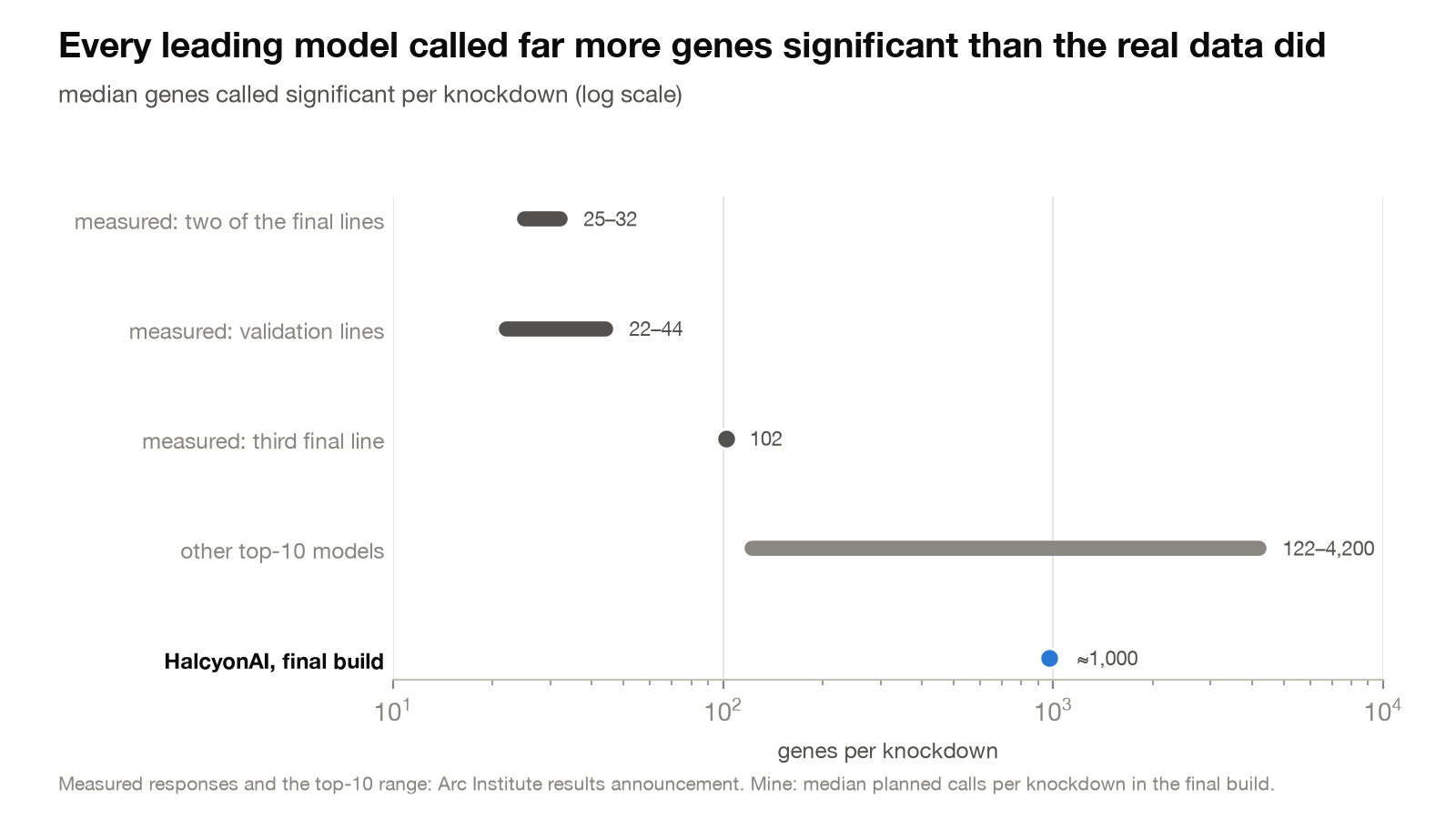
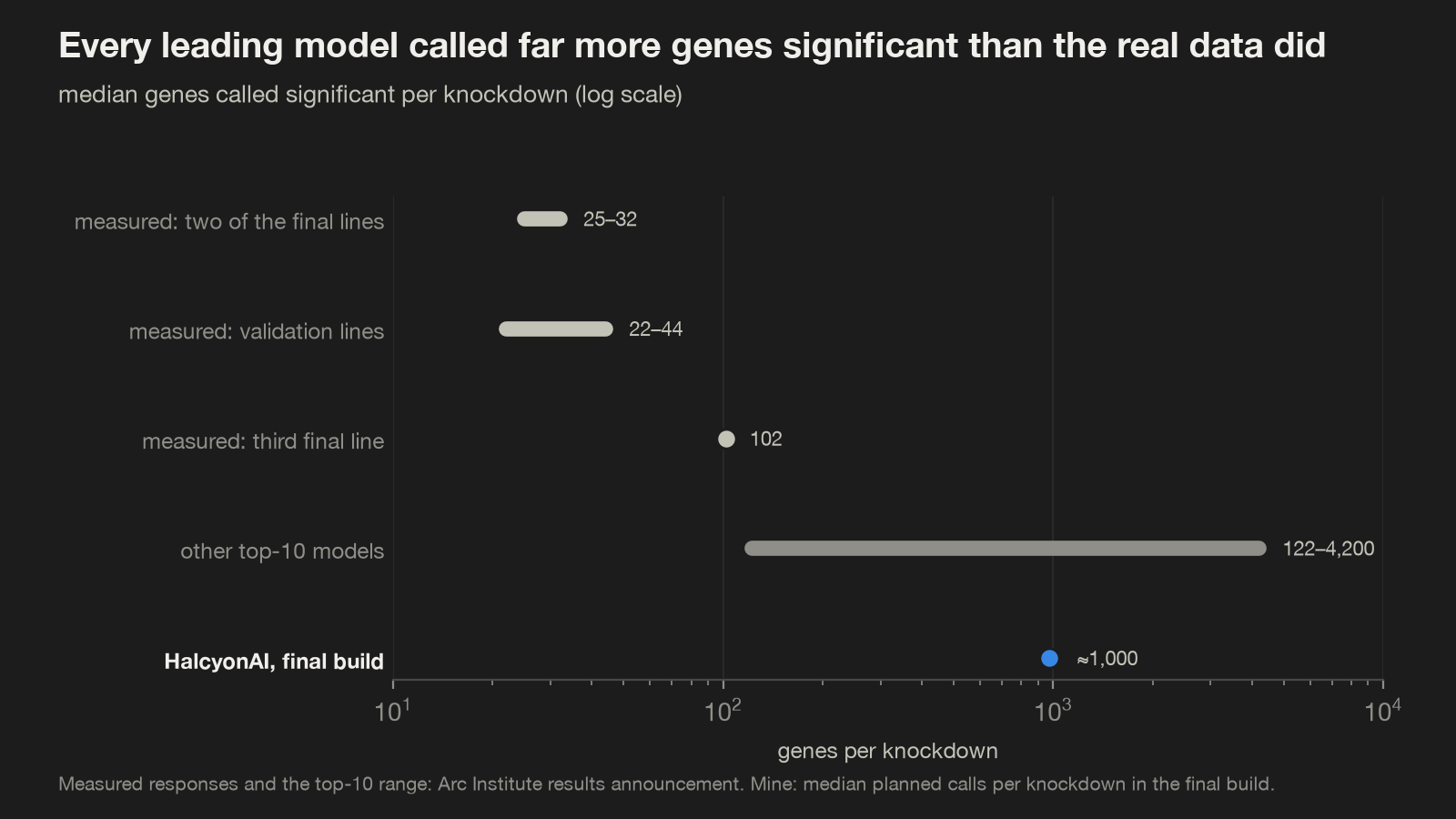
Every top model, mine included, flags far too many genes as changed: about 1,000 per knockdown when real cells show 25 to 100.